



Risk
AuditBoard Recognized in G2’s 2026 Best Software Awards Learn More
February 10, 2026 • 19 min read

Kyle Farmer
Vendor relationships are now inseparable from core operations. Most organizations rely on third parties for critical workflows such as cloud hosting, payroll, data processing, and security — which means important processes now live outside your direct control.
But the accountability doesn’t shift. If a vendor mishandles data, experiences a breach, or falls out of regulatory compliance, your organization is still on the hook. That’s why third-party risk management can’t rely on gut feelings or scattered documents. You need clear processes to assess and manage these risks.
Cue your vendor risk assessment checklist. This structured process helps you see risks clearly, evaluate them consistently, and put mitigation steps in place to ensure thorough, repeatable, and auditable vendor evaluations.
Here’s how you create a third-party risk assessment checklist and tailor it to your organizational needs.
Vendor ecosystems are growing rapidly. Teams now work with hundreds of third parties for core functions. In fact, the companies in Whistic’s recent report say they work with an average of 237 vendors.
Every one of those vendors extends your operational footprint. Think of it like adding extra doors to your building. Each door is useful, but every door also needs to be locked, monitored, and checked regularly.
And when those “doors” aren’t consistently checked, the risks become clear. According to Mitratech, 61% of companies experienced a third-party-related security breach between 2023 and 2024 — a whopping 49% increase from the year before.
But the fallout of these incidents goes beyond the direct costs. Gartner found 84% of organizations experienced operational disruption due to missed vendor risk issues. And that disruption means delays, downtime, lost trust, and strained customer relationships — all problems that cost your organization money.
A structured vendor risk assessment checklist helps teams understand where risk enters the business and how to control it before it spreads. Here’s why a checklist is so important.
Without a standard process, vendor reviews vary depending on who is doing them and how risk-averse the reviewer is. One reviewer may ask for SOC 2 reports and probe deeply into data handling, while another may rely only on a basic questionnaire to keep things moving. That means what gets reviewed and how deeply it’s reviewed changes from vendor to vendor.
This inconsistency makes it difficult to explain why one new vendor was approved and another wasn’t. This makes it almost impossible to defend those decisions during an audit or incident review.
The other consequence is more dangerous: security and compliance gaps. When everyone follows their own approach, it’s easy to overlook vulnerabilities and cybersecurity risks, leaving your organization open to security incidents, compliance failures, operational disruption, and uncomfortable questions from stakeholders.
With a standardized checklist, you review every vendor in the same way. This consistency reduces blind spots, captures evidence, and supports repeatable, scalable decision-making that stands up to audits and leadership questions.
To build trust with regulators and stakeholders, you need to show how you assess and manage risks. A clear, documented, repeatable process demonstrates responsible oversight, not just good intentions.
Then, if an incident does occur, you can prove your organization took reasonable, consistent steps to prevent it. This protects confidence with executives, regulators, and customers when it matters most.
A robust vendor risk assessment checklist provides the structure to review every vendor in the same way and to the same standard.
Use the components below as your master framework, adapting depth based on vendor criticality and data exposure.
Start by identifying the vendor and exploring their role within your organization.
This section should include details about who the vendor is, what they do, and what access they’ll have:
This step prevents misunderstandings about what the vendor will actually do or access. It also helps you determine the level of risk from the start by clarifying whether the vendor will interact with sensitive data, critical systems, or core business processes.
Knowing this risk level helps you understand how deeply you need to assess the vendor.
If your vendor is non-compliant, you’ll still be held responsible. To prevent accidental non-compliance, validate vendor systems to ensure they meet regulatory requirements.
In this section, include checks on whether the vendor meets the laws, frameworks, and compliance requirements relevant to your industry:
Imagine approving a vendor only for them to fold, get acquired, or cut services six months later. A company’s financial and operational stability directly affects your business continuity, so you need to assess these risks early.
These checks should look into their long-term business health:
If a vendor can’t sustain operations in the long term, the threat becomes yours. You risk interrupted services, delayed projects, reputational fallout, and unexpected replacement costs.
When a vendor touches your data or systems, their security becomes part of your security. If they fail, you absorb the damage. And it’s a double hit. You face the costly technical fallout of the incident and the regulatory or contractual consequences of failing to protect that data.
Dig into each vendor’s IT security and data protection to look for gaps across the system:
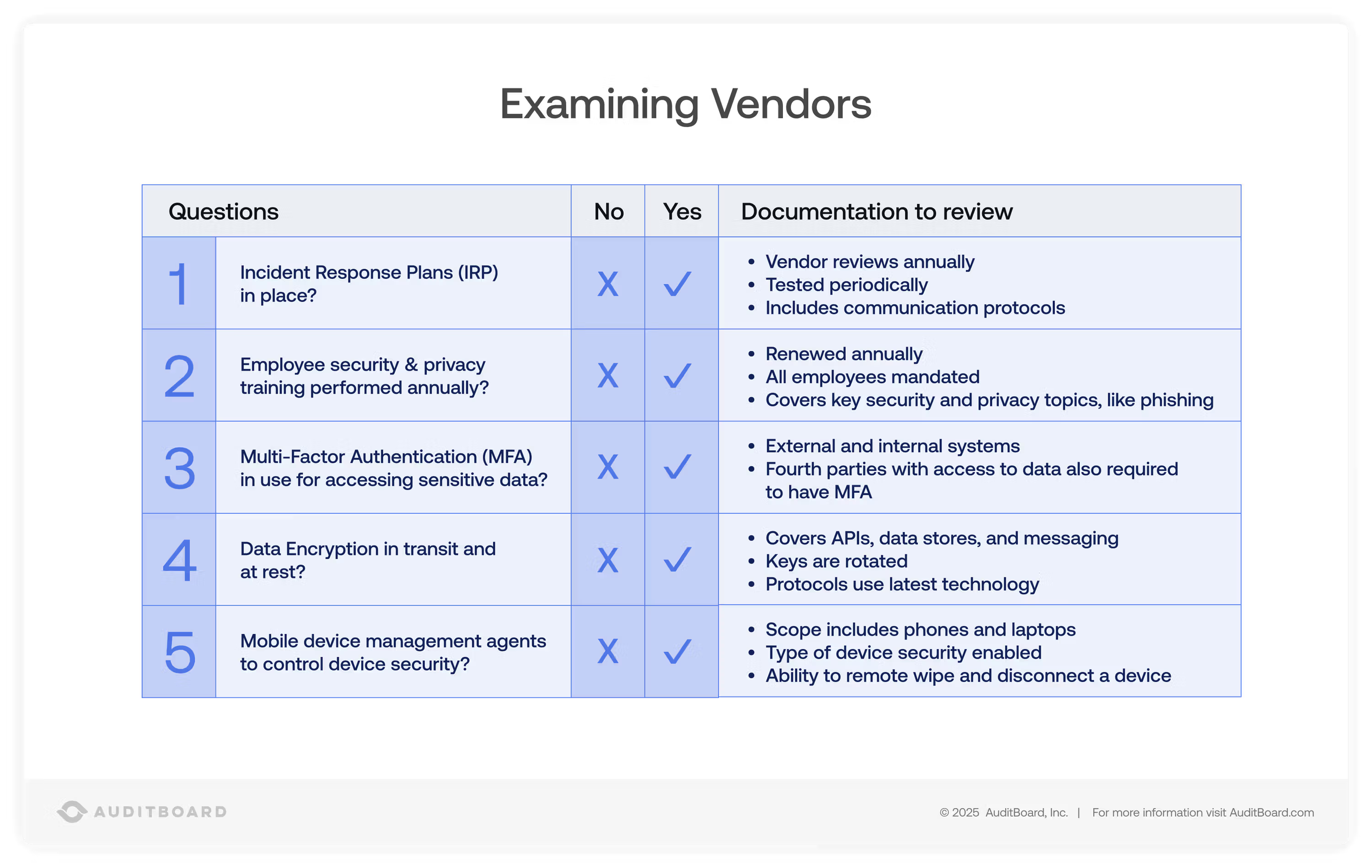
Making sure vendors meet your security standards safeguards both your data and your compliance position.
Confirm the vendor can continue service during outages, disruptions, or emergencies.
This section should look at the risk management plans and processes they have in place to handle downtime:
When a vendor has strong business continuity plans, it reduces the risk of downstream disruption to your customers and operations.
Once you understand the vendor’s risks and capabilities, you need to formalize how you’ll manage them. Contracts turn expectations into obligations, clearly defining who is responsible when something goes wrong.
In this section, confirm and document the legal and financial protections in place:
Strong documentation ensures accountability is clear from the outset. If incidents do happen, these contracts serve as your safety net, guiding how quickly you can respond and who is responsible for remediation.
Once you’ve gathered information, you need a structured way to quantify vendor risk and decide where to focus vendor management efforts. Scoring brings consistency to those decisions and makes them easier to explain to stakeholders, auditors, or regulators.
Begin by defining what matters most based on your organization’s risk profile. Consider factors like data sensitivity, system access, financial stability, and regulatory requirements.
Assign weights to each factor to indicate importance. A vendor handling sensitive data, for example, should carry more weight than one providing a non-critical utility.
Scoring isn’t a perfect mathematical system. What’s important is that you’re consistent.
These models help apply the same logic across every vendor:
Once scoring is complete, group vendors into tiers so you know where to focus time and oversight:
Tiers keep the process efficient, so it’s thorough where it needs to be and streamlined where it doesn’t.
The core checklist provides structure, but not every vendor needs the same level of scrutiny.
Here’s how you tailor your checklist so the process fits your industry, risk tolerance, and operational reality.
Different industries face different regulatory and data sensitivity demands. For example, healthcare and finance require tighter controls around data handling and audit evidence, while manufacturing may focus more on supply chain continuity.
Align your checklist with the standards and regulations that apply to your environment.
Not all vendors carry the same risk. A vendor with access to sensitive data or core systems should go through deeper assessment than one providing a low-impact utility service.
Use your risk scoring model to determine how deep to dig. Update question score weighting to reflect the risk.
Vendor risk isn’t static.
Reassess vendors on a set schedule (e.g. annually for medium-risk, quarterly for high-risk) and any time something changes, such as scope expansion, an incident, ownership change, or compliance lapse.
A checklist only works if it’s used consistently. Operationalizing the process ensures vendor due diligence reviews don’t stall, get bypassed, or vary by who is running them.
Define who is responsible for each step. For example, procurement initiates reviews, security looks at controls, and legal finalizes the contracts.
Set clear timelines so assessments don’t hold up onboarding. Otherwise, unclear ownership means reviews either stall or get forced through just to keep things moving.
Assessment results should lead to informed decisions. If your assessments identify gaps, assign remediation tasks with deadlines and owners. This keeps issues visible and prevents them from being “noted and forgotten.”
Spreadsheets and email are hard to track and scale. Instead, use a Governance, Compliance, and Risk (GRC) platform to centralize vendor data, automate workflows, store evidence, and provide dashboards for oversight.
By digitizing the process, you’ll improve consistency, speed up approvals, and strengthen auditability.
AuditBoard’s third-party risk management (TPRM) capabilities bring structure, consistency, and visibility to the vendor review lifecycle, helping teams assess risk without adding administrative overhead.
Here’s how.
AuditBoard provides a single place to maintain your vendor assessment checklist and scoring framework.
Teams can use shared templates, reference documentation, and weighted models to evaluate every vendor against the same criteria. Evidence, approvals, and notes live alongside the vendor record to create a clean audit trail that’s simple to review later.
Instead of managing reviews through email threads and disconnected documents, AuditBoard routes tasks to the right people automatically.
This means follow-ups, reminders, and escalations happen in the background, and remediation items stay visible until resolved. That way, reviews keep moving without anyone manually pushing or chasing.
Live dashboards show you the state of your vendor risk management ecosystem at a glance, including risk tiers, open issues, overdue tasks, control gaps, and remediation progress.
With clear visualizations, leaders get context, not just raw data, and teams can drill into any vendor’s assessment history with full traceability.
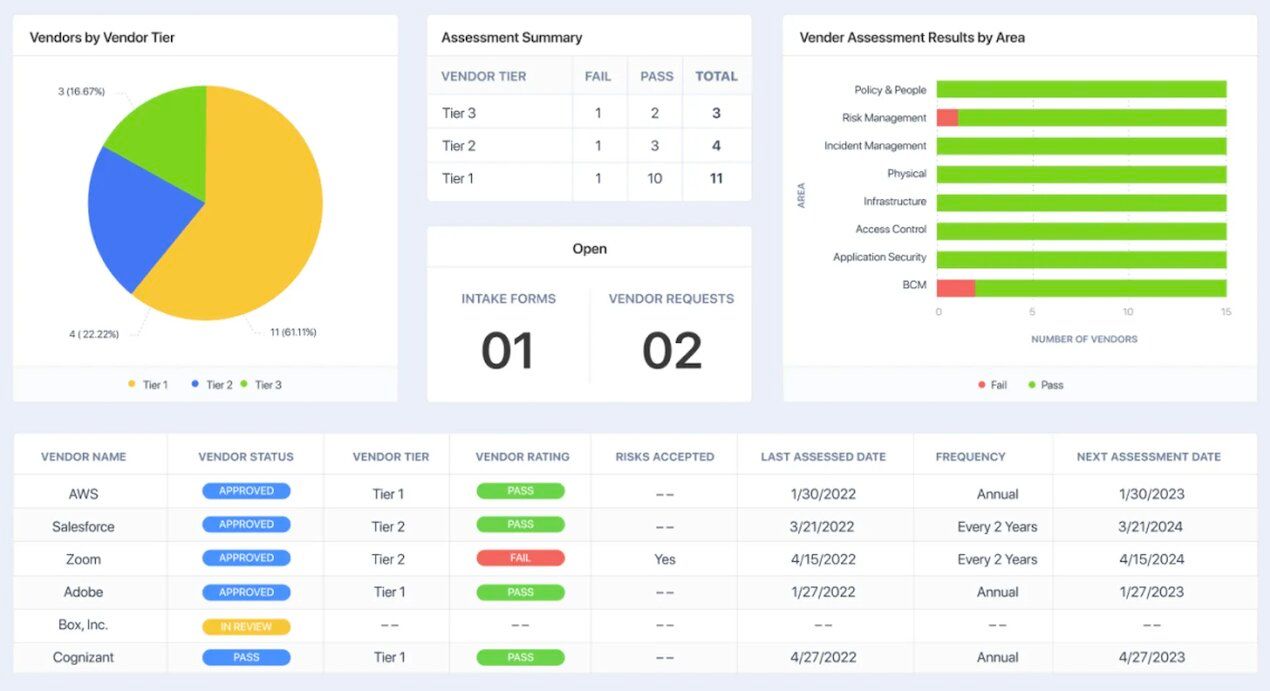
Centralizing assessments and documentation in this way makes conversations with executives, auditors, and regulators clearer and more confident. Everything is traceable and grounded in data.
As Adam Hardy, Internal Audit Manager at TopBuild, says about using AuditBoard: “Sharing information with the external auditors, once it’s gone through our review, is streamlined and seamless and actually functions the way that you would expect it to.”
A structured vendor risk checklist helps you spot potential risks early, stay compliant, and make decisions you can defend.
The key lies in having a consistent method of evaluation, so you’re asking the same questions, using the same scoring, and producing the same documentation every time.
This is where a GRC platform like AuditBoard can help. It standardizes checklists, centralizes evidence, and keeps reviews moving automatically. If you’re ready for a vendor risk process that’s consistent, traceable, and easy to defend, book a demo today.
Kyle is an Information Security professional with a background in GRC and cybersecurity operations. With experience supporting clients at Accenture, Ernst & Young, and AuditBoard's Product Solutions Team, Kyle has a passion for helping organizations improve their information security posture and reduce risk. He now helps organizations navigate GRC transformation with a technology-driven approach.