





InfoSec
Infosec Compliance Now | Virtual | February 25, 2026 | 4 CPE Credits Register Now
February 5, 2026 • 16 min read

Guru Sethupathy
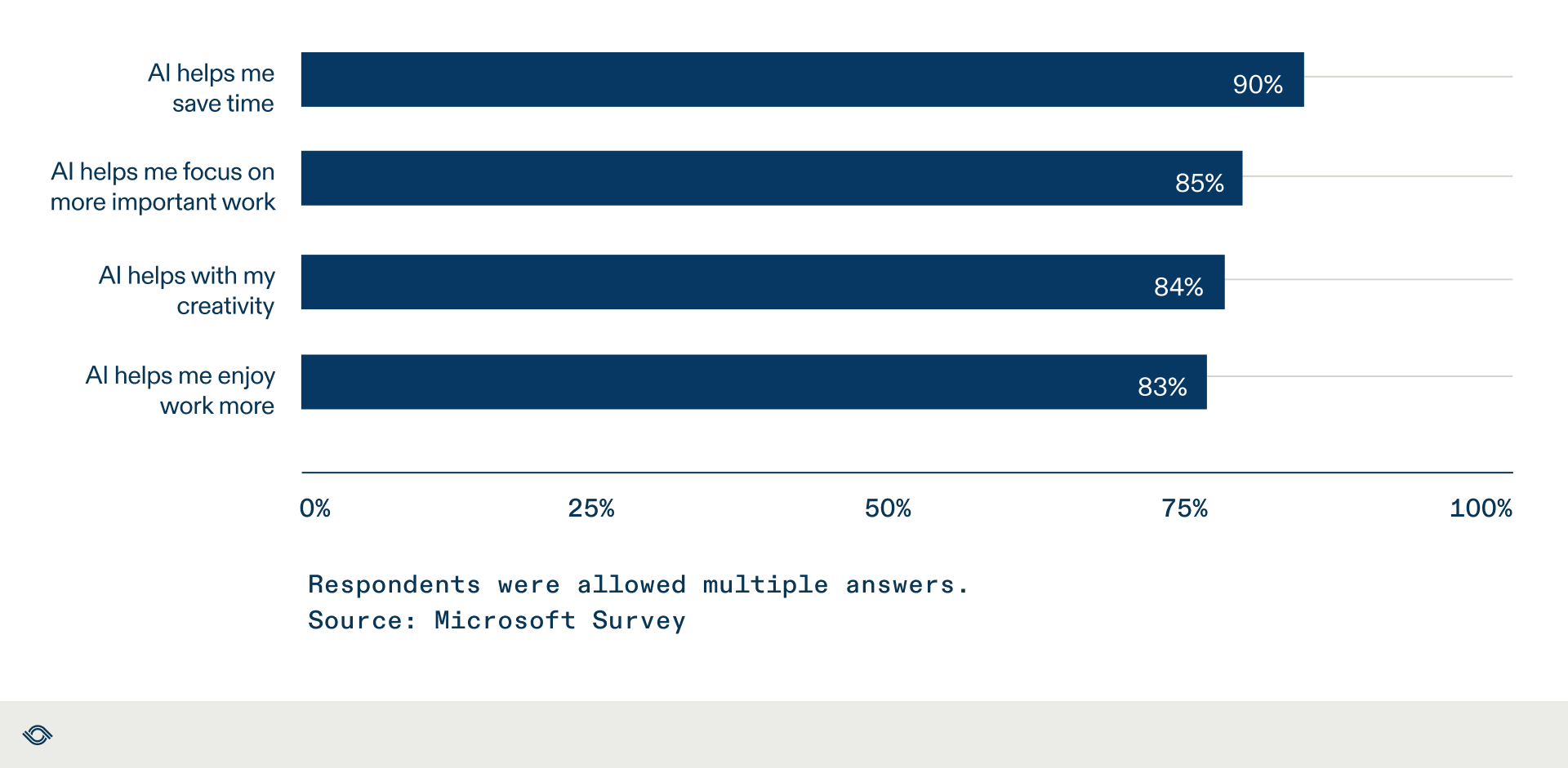
The majority of technology workers use AI at work, according to a recent Gallup Workforce survey of more than 22,000 individuals. Workers use AI primarily to save time, increase productivity, and refocus on the most important and enjoyable work tasks.
While employee-originated AI use cases can be high-value, there are real risks to adopting new AI capabilities in the workplace. These risks can be performance-related, reputational, or legal/regulatory. Protecting your business from these risks requires stringent policies and procedures governing employees' use of AI.
Not all AI is created equally. And AI that isn’t properly vetted or sanctioned can pose serious risks to businesses. Examples of unsafe or risky AI usage behaviors can include:
An AI usage policy is a document that helps employees understand AI use cases permitted within the organization. It defines which uses are acceptable and outlines the process for an employee to have their specific use cases reviewed for approval. There are multiple benefits to creating an AI usage policy:
The primary intent of an AI usage policy is to create transparency for the entire organization. When written well, AI usage policies help employees feel comfortable adopting AI safely while reducing uncertainty and risk.
A comprehensive AI usage policy contains the following five sections:
In this section, the organization should clarify its stance on AI in the workplace.
Example text for two different companies with different risk tolerances might include:
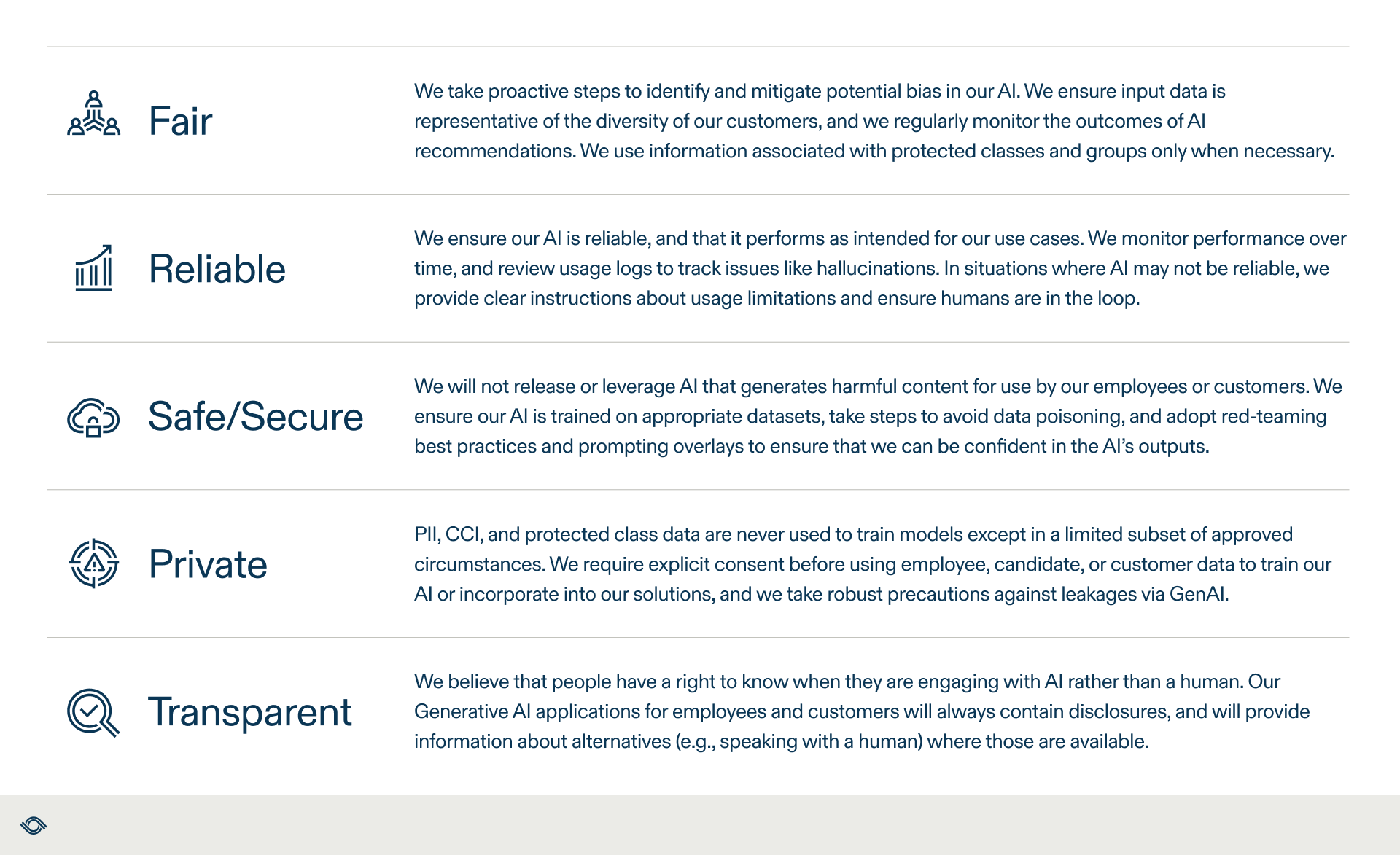
The company should also articulate its AI usage principles, which will serve as a north star for employees. Examples might include a focus on data privacy, transparency, fairness, and ethical considerations.
Section 2: AI technologies employees can use
In this section of the AI usage policy, the organization should outline which tools employees may use for work-related activities.
An organization’s AI or technology group is responsible for reviewing which technology and capabilities employees can use. Their review should include an assessment of:
In many cases, an organization will sign specific contracts with AI providers to ensure internal data is secure and not used for further model training or sale. Organizations are likely to have preferred providers with contracts in place.
Prohibiting AI use for business on personal devices: Organizations typically prohibit employees from using AI for business on personal devices such as laptops and cell phones. Organizations must outline those requirements.
Section 3: Acceptable AI uses
This is a core section of any AI usage policy. Section 3 defines which uses are always allowed, which are always prohibited, and which may be allowed with further guidance and review.
In this section, organizations should establish guardrails for AI use and provide examples to ensure employees understand what they entail. Below are example guardrails to consider:
Acceptable AI uses:
Prohibited AI uses:
AI uses that may be acceptable but require further review:
Organizations should align their acceptable AI usage principles with their risk appetite and core industry/function. Common use cases for an organization — e.g., using AI to summarize meeting notes — should be called out directly.
Section 4: Process for requesting use case review
While there will be some clear approved or prohibited use cases that employees will encounter, many new uses for GenAI will not be clear-cut: they may offer significant benefit to the business, but could also pose meaningful risks.
Organizations should establish a clear process for employees to suggest new use cases for further review. These reviews often involve central intake and evaluation by one or more experts on AI risks/benefits, and will include a committee of:
An organization’s AI usage policy will include details about how an employee can submit their use case, an initial intake form with relevant details, and a view of next steps in the review process and expectations.
In our experience, once an organization sets up this review process, it can receive tens to hundreds of potential AI use cases from employees over the following weeks and months.
The process of collecting relevant information, triaging risk and compliance views, and tracking approved and prohibited AI use can become overwhelming if it isn’t streamlined. To help keep track of AI use, many organizations turn to AI governance platforms to stay on top of varied use cases and risks.
Section 5: AI usage and risk monitoring
Reviewing and approving an AI use case is usually not the last component of safe AI adoption — especially for AI that has high value but higher risk. Often, AI use comes with conditions that may involve ongoing monitoring or review of outcomes.
For example, a high-risk AI use case in HR might involve an AI tool that helps recruiters rank-order potential candidates for a role. This can save recruiters and hiring managers significant time and help them achieve better outcomes — but it is critical to review a technology like this for performance and bias on an ongoing basis. Once AI usage has been approved, the organization may require ongoing testing and review of outcomes to ensure it remains appropriate over time.
The AI usage and risk monitoring section of an organization’s AI usage policy should outline how employees should engage with and ensure safe use of the AI on an ongoing basis.
Download AuditBoard’s employee AI usage policy template here and learn how to:
Misuse of AI can create significant risks for organizations, employees, and customers. This makes it critical for organizations to track AI adoption and ensure employees engage with the new technology safely. Organizations can monitor for AI misuse in two core ways:
Typically, AI usage policies link to an organization’s code of conduct, and companies may monitor compliance in the same way they monitor other violations of their internal guidelines.
Reviewing employee adoption of AI across an organization can become a substantial effort.
Employees — focused on innovation, productivity, and elevating business outcomes — can generate varied and creative uses for AI. But evaluation and monitoring of high-risk, high-value use cases can quickly become taxing.
AI governance platforms like AuditBoard can reduce the burden of reducing AI risk and staying compliant by:

Guru Sethupathy is the VP of AI Governance at AuditBoard. Previously, he was the founder and CEO of FairNow (now part of AuditBoard), a governance platform that simplifies AI governance through automation and intelligent and precise compliance guidance, helping customers manage risks and build trust and adoption in their AI investments. Prior to founding FairNow, Guru served as an SVP at Capital One, where he led teams in building AI technologies and solutions while managing risk and governance.