





InfoSec
AuditBoard Recognized in G2’s 2026 Best Software Awards Learn More
February 12, 2026 • 21 min read

Guru Sethupathy
With new regulations like the EU AI Act on the horizon, the era of deploying AI without rigorous documentation is over. Regulators, customers, and other stakeholders are demanding proof that your models are fair, safe, and transparent. Simply stating that your AI works is no longer enough; you have to show your work. This is where model cards become essential.
For any enterprise leader, understanding a model card report is now a critical part of your compliance strategy. It serves as the official record of a model’s purpose, usage, testing, and limitations, providing the evidence auditors need to satisfy and build trust. It’s your primary tool for demonstrating due diligence in an increasingly regulated environment.
Think of a model card as a cross between a nutrition label and an instruction manual for an AI model. At its core, a model card is a structured overview of how an AI model was designed and evaluated. A typical model card structure includes the model’s name and version, its intended use cases, and details about its architecture. It includes how the model should be monitored or overseen by users. It also covers the data used for training, key performance metrics, and, most importantly, any known limitations or ethical considerations. This includes potential biases or scenarios where the model is likely to underperform, giving developers and users a clear-eyed view of what the AI can and cannot do.
It’s a key artifact in any responsible AI framework, aiming for transparency in development. By clearly outlining a model’s components and performance metrics, model cards help everyone involved understand its specific strengths and weaknesses. This is especially critical when models are used for high-stakes decisions, like predicting health risks or financial outcomes. They provide the necessary details about how well a model works under various conditions, which is fundamental for risk management and ethical oversight.
Model cards can help satisfy compliance requirements under laws such as the EU AI Act, Colorado SB205, and NYC Local Law 144. It’s not just another piece of documentation to file away; it’s an active tool that brings clarity and structure to your AI systems. By making model cards a standard part of your workflow, you create a powerful framework for managing risk and building trust with everyone who interacts with your AI.
While the exact format can vary, a useful model card typically includes several key sections that provide a complete picture of the model:
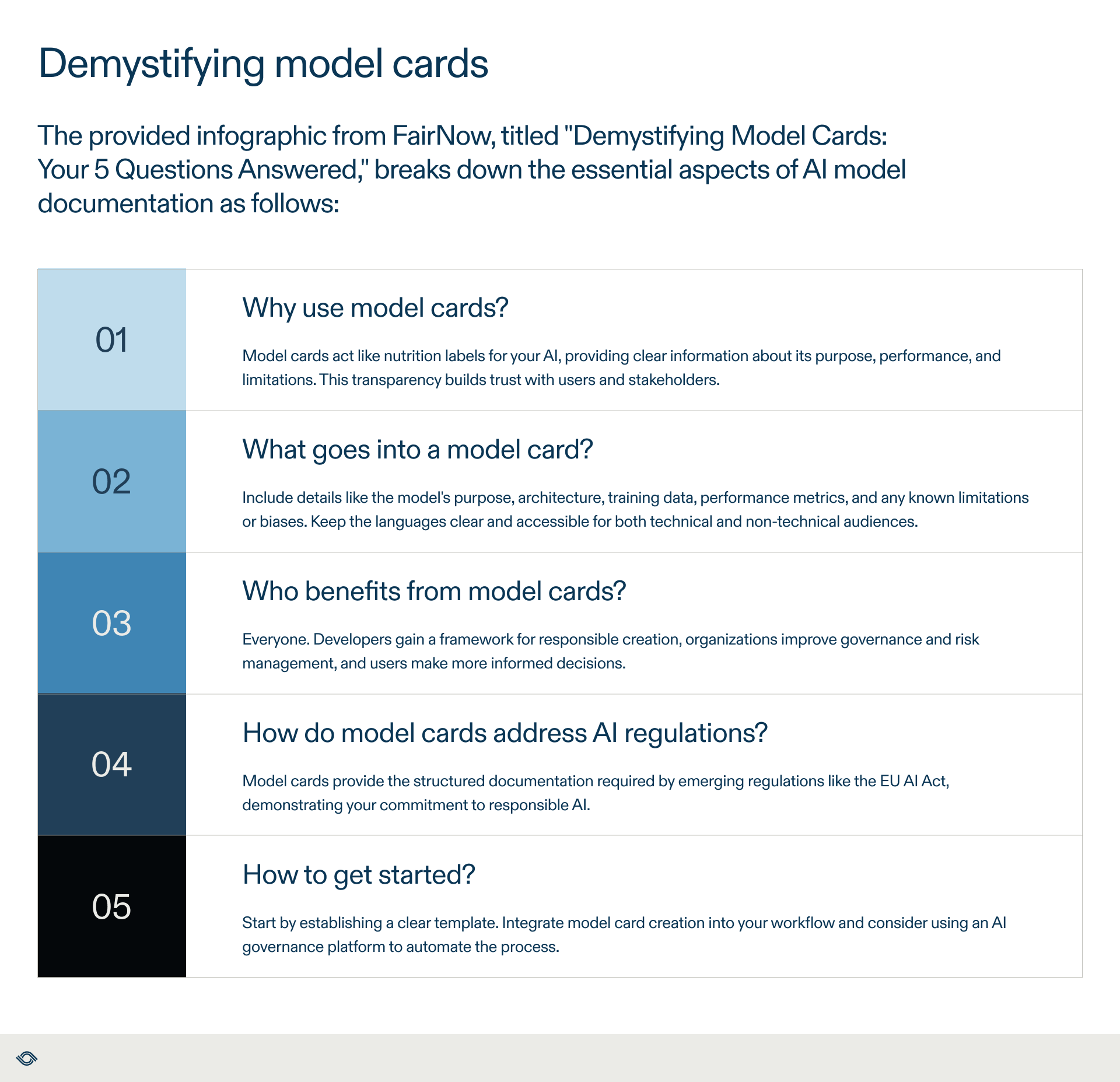
Think of a model card as a fundamental component of your AI governance strategy. They can help satisfy compliance requirements under laws such as the EU AI Act, Colorado SB205, and NYC Local Law 144. It’s not just another piece of documentation to file away; it’s an active tool that brings clarity and structure to your AI systems. By making model cards a standard part of your workflow, you create a powerful framework for managing risk and building trust with everyone who interacts with your AI.
For any organization serious about deploying AI responsibly, especially in high-stakes fields like HR and finance, model cards are non-negotiable. They provide a clear, consistent record of what an AI model is, what benefits (and risks) it provides, and how it should be used. This documentation is the bedrock for building systems that are not only effective but also fair, transparent, and accountable from the ground up.
Transparency is the currency of trust, and model cards are part of how you earn it.
They function as a straightforward, structured overview of an AI model’s purpose, design, and performance. By clearly documenting how a model was created and evaluated, you provide stakeholders — from developers and business leaders to regulators and end-users — with the information they need to understand its capabilities and limitations. This isn’t about revealing proprietary code; it’s about being open about the model’s intended uses and known blind spots. This level of clarity helps demystify AI, making it more approachable and reliable. It represents a significant step towards responsible AI development by standardizing how models are reported, ensuring everyone has a shared understanding of the technology.
Model cards introduce a necessary layer of discipline into the AI development lifecycle. By requiring a standardized report, you prompt teams to think critically about their choices and document them for review. This process drives accountability by creating a clear record of a model’s performance metrics, especially across different demographic groups.
The original framework for model cards emphasizes reporting performance across subgroups, such as race or gender, to proactively identify and address potential biases. When developers know they need to report these findings, they are more likely to build fairness checks into their process from the start. This documentation creates a clear line of sight into a model’s behavior, making it easier to diagnose issues and hold the right teams accountable for building equitable AI.
Creating a model card isn’t just another box to check in your development process — it’s an exercise in clarity and responsibility. A well-constructed model card acts as a central source of truth, providing a clear, honest summary of your AI model for anyone who needs to understand it, from fellow developers to customers to the C-suite. The goal is to build a document that is both comprehensive in its technical details and accessible in its language. The process starts with determining what information to gather, then committing to presenting it with absolute clarity.
Think of it as creating a user manual for your model. You need to provide enough detail for a technical user to understand its architecture and performance, while also giving a non-technical stakeholder the information they need to assess its risks and suitability for a specific use case. This balance is key. A great model card preemptively answers the tough questions about fairness, performance, and limitations, making it a foundational element of a strong AI governance framework.
Model cards aren’t just technical documents for developers; they are essential guides for everyone who interacts with an AI system. They also serve as a user manual for your AI. They translate complex technical information into practical insights, giving your teams the context they need to use AI tools responsibly and effectively. They should clearly explain the technical instructions for use, which settings or options the user controls, how results should be interpreted, and which uses require additional human oversight or should be avoided altogether. Organizations that sell AI to customers should also explain how to monitor the AI system after deployment.
When users understand the “how” and “why” behind an AI’s output, they move from being passive recipients of technology to active, informed participants. This shift is fundamental to building a culture of trust and accountability around AI within your organization. It empowers your people to ask the right questions and use AI with confidence.
When your team uses an AI tool, they need to trust its outputs. Model cards build that trust by providing clear, concise details on how a model performs under various conditions. These reports show performance metrics across different demographic groups, such as race or gender, to clearly highlight potential biases. This transparency is critical.
For example, an HR manager using an AI-powered hiring tool can consult its model card to see if it was tested for fairness across different populations. This allows them to make more informed decisions and mitigate risks, rather than unquestioningly accepting the AI’s recommendations. It gives them the power to use the tool as an aide, not an absolute authority.
A model card clearly outlines an AI’s intended uses, capabilities, and, just as importantly, its limitations. By detailing how a model was trained and evaluated, it gives users a realistic picture of where it excels and where it might fall short. This knowledge is crucial for selecting the right model for a specific job and avoiding its use in inappropriate contexts. For instance, a model card might specify that a fraud detection model performs less accurately on certain transaction types. This helps your team understand a model’s purpose and limitations, preventing misapplication and improving overall operational effectiveness.
Model cards are a powerful tool for AI transparency, but putting them into practice comes with its own set of hurdles. Simply deciding to create them is the first step; the real work lies in executing them effectively. Many organizations struggle because the process isn’t as simple as filling out a template. To build a truly responsible AI program, you need to anticipate these challenges and create a strategy to address them. Let’s walk through the most common obstacles.
One of the biggest frustrations in implementing model cards is the absence of a universal standard. Different teams and vendors often have their own ideas about what makes a model card “complete.” As researchers have noted, documentation for machine learning models often provides “very little information regarding model performance characteristics, intended use cases, [or] potential pitfalls.” This inconsistency makes it difficult to compare models or trust that the information is comprehensive. Without a clear, organization-wide framework, your model cards can become a collection of documents with varying levels of detail, defeating their purpose of creating clear and consistent AI documentation.
A model card should function as a “boundary object,” an artifact that people with different backgrounds can use. If the language is too technical, it fails to provide transparency to decision-makers. If it’s too simple, it lacks the rigor required by developers and auditors. Finding that balance is critical for a model card to be effective.
A model card isn’t just about performance metrics; it’s a tool for ethical oversight. The challenge is that identifying every potential ethical pitfall is incredibly difficult. It requires you to go beyond standard accuracy scores and actively look for biases, safety issues, and other risks. The development team must identify risks arising from the model's use, assess their potential impact, and decide how to appropriately mitigate them. Overlooking this process can lead to deploying a model that seems fair on the surface but causes real harm.
Putting model cards into practice presents a few common roadblocks, from inconsistent documentation to the sheer effort of manual creation. But these are far from insurmountable. With a clear strategy, you can build a process that makes creating and maintaining model cards seamless within your AI development lifecycle. The key is to focus on standards, integration, and the right technology.
Model cards shouldn’t be an afterthought created right before deployment. To be truly effective, they must be living documents that evolve with the model. Integrate model card creation and updates directly into your development workflow, alongside code reviews and security scans. Update model cards whenever there are significant changes to the model, how it’s used, or who it’s used on.
This process should include documenting how the model performs on different data subsets and explicitly stating its intended uses and limitations. This practice helps you identify potential performance gaps or areas of concern early on. By making model cards an integral part of your machine learning development process, you transform transparency from a final-step chore into a continuous, value-adding habit.
Manually creating and updating mModel cCards for every model is not scalable, especially in a large enterprise. It’s time-consuming and leaves room for human error. This is where automation becomes essential. The right tools can extract information directly from your development and monitoring systems to automatically populate sections of the model card. Pull information directly from your development and monitoring systems to automatically populate sections of the model card.
Platforms designed for AI governance can streamline this entire process. With a centralized solution like AuditBoard, you can automate risk tracking, manage compliance, and generate consistent documentation across all your models. Using a purpose-built framework removes the manual burden from your teams, allowing them to focus on building great models while the system handles the necessary transparency reporting. This approach makes responsible AI adoption achievable at scale.
Model cards are more than just a good practice; they are quickly becoming a cornerstone of responsible AI strategy. As organizations scale their use of artificial intelligence, these documents will play a critical role in managing risk and complying with a complex web of new rules. Their future lies not in static documents but in dynamic tools integrated directly into the AI lifecycle. This evolution is being driven by two major forces: the rapid emergence of AI-specific regulations and the growing need for comprehensive AI governance frameworks to manage models at scale. For any organization serious about deploying AI ethically and effectively, understanding this trajectory is essential for staying ahead.
As governments worldwide roll out new rules for artificial intelligence, model cards are shifting from a “nice-to-have” to a “must-have.” Regulations like the EU AI Act place heavy emphasis on transparency and documentation, requiring organizations to demonstrate that their models are fair, safe, and perform as intended. A well-constructed model card serves as clear evidence of this due diligence. It provides regulators with a standardized, easy-to-understand report on a model’s purpose, limitations, and testing protocols. This proactive documentation helps you meet compliance obligations and demonstrates a foundational commitment to responsible AI, building trust with both regulators and the public.
Model cards are most powerful when woven into the fabric of your organization’s AI governance framework. Instead of being an afterthought, they should be a living document that connects development, risk management, and compliance.
Integrating model cards into your workflow creates a centralized, authoritative record for every model you deploy. This approach provides a clear line of sight into your entire AI ecosystem, which is critical for maintaining control and accountability. As explained in the NIST AI Risk Management Framework, effective governance requires structured documentation to map, measure, and manage AI risks, and model cards are the perfect tool for the job.

Guru Sethupathy is the VP of AI Governance at AuditBoard. Previously, he was the founder and CEO of FairNow (now part of AuditBoard), a governance platform that simplifies AI governance through automation and intelligent and precise compliance guidance, helping customers manage risks and build trust and adoption in their AI investments. Prior to founding FairNow, Guru served as an SVP at Capital One, where he led teams in building AI technologies and solutions while managing risk and governance.