


Compliance
AuditBoard Recognized in G2’s 2026 Best Software Awards Learn More
February 9, 2026 • 18 min read

Rena Ding
Manual compliance is a grind. Evidence requests pile up, testing cycles never seem to end, and reporting eats up hours you don’t have. Compliance automation tools step in to help relieve this burden. With the right compliance automation platform, you cut repetitive tasks, reduce human error, and maintain an audit-ready compliance status. But how do you choose the right compliance software for your company?
Here’s a detailed comparison of eight tools that streamline compliance and connect your work to the bigger picture of risk and audit.
The right compliance automation software can transform the way you manage audits, evidence requests, and ongoing reporting.
Today’s best compliance software doesn’t just cut repetitive work. It also connects compliance with audit and enterprise risk to give leaders real visibility.
Here's a breakdown of the top automated compliance platforms to help you find the right fit.
Best all-round for compliance teams needing workflow automation and connected risk.
AuditBoard is a cloud-based platform that unifies compliance, risk, and audit management. It automates evidence collection and control testing to achieve continuous compliance monitoring while connecting compliance with enterprise risk and audit for full visibility.
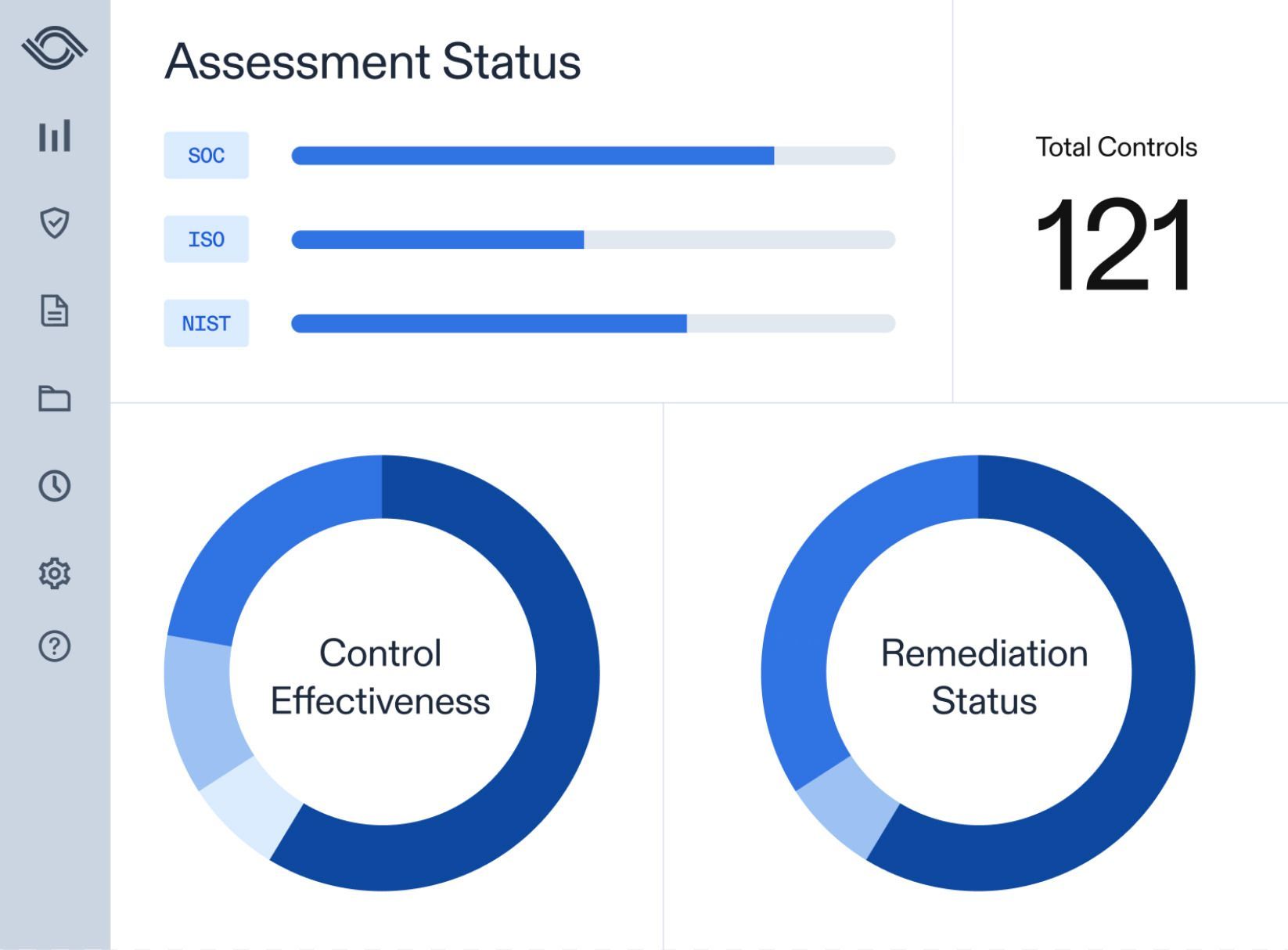
With modules like CrossComply, SOXHUB, OpsAudit, and RiskOversight, AuditBoard supports frameworks from SOC 2 and ISO 27001 to SOX, GDPR, HIPAA, and NIST. Its intuitive interface drives adoption while its scalability makes it a strong fit for organizations managing multiple frameworks.
Best fit: Mid-market and enterprise teams that need to scale compliance across frameworks while linking activities with risk and audit
Top features:
Strengths:
Trade-offs:
Strong controls library, less ERM focus.
Hyperproof focuses on control management, with a robust library and automation to simplify multi-framework compliance. It streamlines evidence collection, reminders, and monitoring, but lacks the enterprise depth in risk assessments that broader governance, risk, and compliance (GRC) platforms have.
Best fit: Mid-market teams managing multiple compliance frameworks who need strong control mapping and automation without heavy ERM integration
Top features:
Strengths:
Trade-offs:
Ideal for startups/SOC 2, limited enterprise depth.
Drata accelerates SOC 2, ISO 27001, and HIPAA compliance for startups through continuous monitoring and automated evidence collection. It integrates seamlessly with cloud tools, but larger enterprises may find its reporting and scalability limited.
Best fit: Startups and high-growth SMBs needing fast SOC 2 or ISO automation with minimal setup.
Top features:
Strengths:
Trade-offs:
Quick compliance automation, SMB-oriented.
Vanta helps small and mid-sized businesses fast-track SOC 2, ISO 27001, HIPAA, and other certifications via automation and continuous monitoring. It connects directly to cloud and SaaS systems to collect evidence and flag issues in real time.
Its speed and affordability make it appealing to growing companies, though enterprises may find it has limited depth.
Best fit: SMBs and startups needing affordable, rapid compliance automation.
Top features:
Strengths:
Trade-offs:
Fast SOC 2 prep, narrow use case.
Secureframe specializes in helping startups and SMBs achieve ISO 27001 and SOC 2 compliance quickly. It automates evidence collection, policy generation, and control monitoring through integrations with cloud and SaaS systems.
Its focus makes it effective for audit readiness, but it lacks breadth for multi-framework or enterprise compliance.
Best fit: Companies needing the fastest route to SOC 2 or ISO 27001.
Top features:
Strengths:
Trade-offs:
Wide framework support, heavy lift.
OneTrust is a comprehensive GRC platform supporting 50+ global frameworks, with deep privacy and data protection modules. It connects compliance, risk, and ethics across multinational environments. Its scalability and flexibility suit global enterprises, but the platform requires significant resources to implement and maintain.
Best fit: Large enterprises with complex, multinational compliance needs
Top features:
Strengths:
Trade-offs:
Highly configurable, more complex.
LogicGate’s Risk Cloud is a no-code GRC platform that lets teams design custom compliance and risk workflows.
It’s ideal for organizations with unique needs, as its configurability supports non-standard frameworks. However, it has a long setup time and needs skilled admins to manage it.
Best fit: Enterprises with complex or custom compliance requirements
Top features:
Strengths:
Trade-offs:
Robust, enterprise legacy option.
Archer (formerly RSA Archer) is one of the most established enterprise GRC platforms, with deep modules for risk, audit, and compliance.
It’s proven at scale and highly customizable, but its legacy design and heavy implementation needs can slow adoption compared to newer cloud-native tools.
Best fit: Large, highly regulated enterprises needing deep GRC coverage
Top features:
Strengths:
Trade-offs:
Compliance teams are under pressure like never before — and that pressure is only increasing.
As a report by Grant Thornton found, 77% of organizations expect more regulatory requirements this year. And according to NorthRow, almost half of compliance leaders view this constant change as a direct threat to their programs.
With so much in flux, true automation has to go beyond reducing manual tasks. It should keep compliance modules up to date, ensure your system stays audit-ready, and connect frameworks so they work together instead of in silos.
Here’s how the best compliance automation tools deliver real value.
Traditional evidence collection means chasing files, screenshots, and emails that go out of date almost instantly.
Automated platforms connect directly to your cloud, SaaS, and HR systems, pulling live data into one place. That way, compliance records stay current, audits run smoothly, and teams cut out errors that often trigger compliance violations.
According to a recent report by Navex, risk reduction is the top reason that organizations invest in GRC tools.
And they’re right. GRC tools reduce risk in a way that manual checks can’t. Manual checks done once or twice a year leave long gaps where risks slip through unnoticed, often until it’s too late.
Automation solves this with continuous compliance monitoring. The system flags issues immediately so teams can respond in real time.
Organizations often juggle overlapping frameworks like SOC 2, ISO 27001, HIPAA, PCI DSS, and GDPR. Without automation, proving the same control across each framework means duplicate work.
Automated mapping creates a “test once, comply many” model. This model automatically reuses evidence, connects frameworks, and updates compliance status as regulations change.
More than a third of compliance officers are prioritizing data analytics this year, NorthRow reports. That’s because insights are essential for spotting risks early and staying ahead of change.
Modern platforms go beyond static reports, offering real-time dashboards and predictive analytics. These tools highlight patterns and flag weak spots before they become failures.
The right fit depends on your size, maturity, and regulatory compliance scope. Here’s how to decide on which tool fits your compliance strategy.
Smaller teams should look for tools that simplify SOC 2 or ISO 27001. Guided workflows, policy templates, and quick integrations all help achieve compliance without hiring specialists.
As companies grow, overlapping frameworks like HIPAA, PCI DSS, and GDPR create duplicate work. Mid-market teams need automation that reuses evidence, maps controls, and manages several frameworks at once.
Large enterprises need real-time visibility. Continuous monitoring, advanced reporting, and deep integrations connect compliance with risk and audit, ensuring proactive management across global operations.
Choosing a compliance automation tool is a big investment. The wrong fit is both risky and frustrating. To avoid wasted budget and poor adoption, watch out for these common pitfalls.
Vendors often promise complete automation, but no platform removes people from the process entirely. Be wary of broad claims and dig into what’s actually automated versus the tasks that still require manual oversight.
Compliance doesn’t exist in isolation. Your platform needs to integrate with your audit and risk management systems. Otherwise, you’ll create silos, duplicate evidence work, and lose the broader visibility needed for enterprise risk management.
Some tools shine for one framework, like SOC 2 or ISO 27001. But they might fall short when you need to expand. Make sure the platform can scale with your program’s future needs.
A strong compliance automation platform can save time, reduce risk, and keep your business audit-ready. But the market is crowded, and vendor demos often blur together. To make an informed decision, bring a clear checklist of questions to every evaluation.
Here are a few important questions to ask.
Start with your current needs, but think ahead. Does the tool support SOC 2, ISO 27001, HIPAA, GDPR, or other standards you may adopt later?
Native support prevents bolt-on costs down the road.
Ask how the system pulls data from your cloud, SaaS, and HR tools. The best platforms sync continuously, so evidence is always current, not just at audit time.
Compliance doesn’t stand alone. Check integrations with ERP, security, and risk tools to make sure your workflows connect across teams.
Your system should maintain version history, timestamps, and trails to satisfy auditors at any moment — without manual audit preparation.
Confirm what you’re paying for. Some vendors bundle onboarding and training, while others charge separately for setup, premium support, or advanced features.
Compliance automation tools keep you ahead of risks, while aligning frameworks and ensuring you’re audit-ready at all times. But the best way to see the benefits in action is to test it yourself. Schedule a demo with AuditBoard today to explore how it streamlines compliance while linking directly to risk and audit programs.

Rena Ding, a Product Manager at AuditBoard, brings a robust security compliance background from her 7 years as an information security auditor and a PwC alumna. Her expertise spans auditing and consulting on SOC1, SOC2, HIPAA, GDPR, and ISO27001 readiness.