


InfoSec
AuditBoard Recognized in G2’s 2026 Best Software Awards Learn More
January 14, 2026 • 18 min read

Tony Luciani
GRC platforms often look similar in a simple feature list comparison. The real buying challenge is figuring out which tools match your program’s complexity and which will require workarounds as you move beyond a single framework or a small team.
This guide compares leading GRC tools, explains how to evaluate them, and includes an at-a-glance comparison table to help you make a confident, well-informed choice.
Here are the eight GRC solutions we’ll explore:
1. AuditBoard
2. Workiva
3. Diligent One Platform (HighBond)
4. Vanta
5. LogicGate
6. MetricStream
7. Riskonnect
8. ServiceNow GRC
Each GRC platform takes a different approach to scalability, usability, and execution.
This table highlights where the top tools differ most, so you can quickly narrow options based on how your team operates.
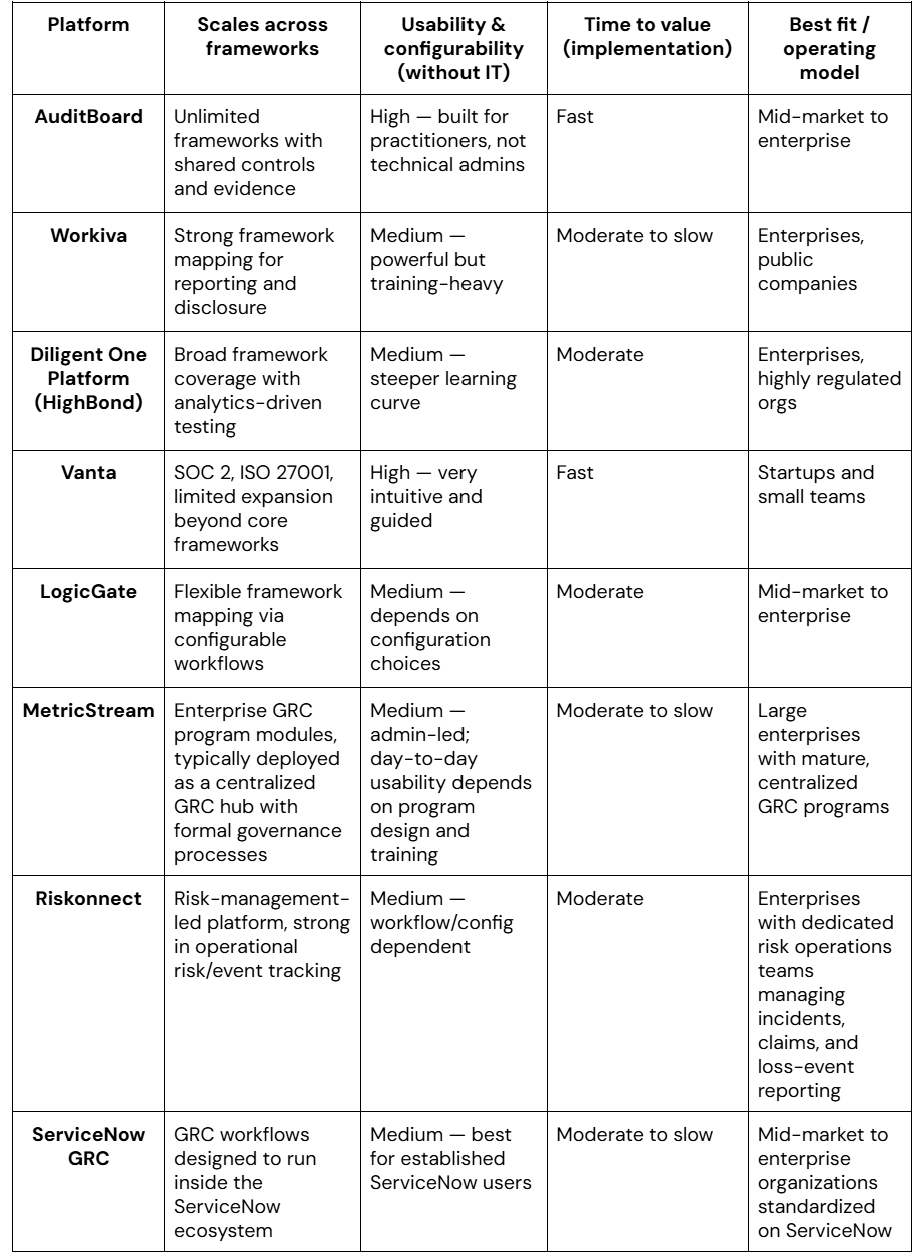
Note: Support varies by package, so confirm the onboarding model and post–go-live support during your evaluation. Data current as of February 2026.
Different GRC tools can look comparable on paper, but they’re optimized for different operating models — reporting and disclosure workflows, audit readiness and control execution, operational risk/event management, or GRC embedded inside an existing enterprise platform.
Each of the following eight tools includes a concise overview, key capabilities, and the use cases for which it’s typically chosen.
AuditBoard is the #1 GRC tool designed to run audit, risk, and compliance as a single, connected program rather than a collection of separate tools. AI-driven GRC software gives you one platform to manage audit work, track compliance activity, and understand how risk shows up across the organization.
That shared foundation cuts down rework and prevents compliance and risk management programs from drifting as requirements evolve. It also makes growth easier to manage, as you don’t need to redesign processes each time the scope expands.
For organizations under regular regulatory scrutiny, AuditBoard serves as a system of record that supports both daily execution and ongoing oversight. AuditBoard is the best GRC tool for practitioners looking for an easy-to-use, customizable platform.
Features
CrossComply sits at the core of AuditBoard’s compliance architecture, using a shared control and evidence layer across audit, risk, and compliance programs. That structure lets teams apply the same work across frameworks — so when you add new standards, you don’t have to start over or duplicate effort. Progress continues as the scope expands, making regulatory change far easier to manage.
Best for
AuditBoard is the best GRC tool for managing multiple frameworks to align cross-functional audit, risk, and compliance across risk registers, control activities, compliance procedures, and compliance reports.
What they say
“What I like best about AuditBoard is how intuitive and user-friendly the platform is. It brings our SOX and operational audits together in one place, which makes collaboration across teams seamless. The automation features save a lot of time by reducing manual work, and the real-time dashboards give great visibility into audit progress and status. Overall, it helps streamline the entire audit process and improves efficiency.” —Sara, enterprise internal audit manager
Workiva is known for enterprise reporting and disclosure workflows.. It’s popular among teams that want to connect narrative and numeric reporting, maintain traceability, and support corporate governance requirements involving finance, legal, and compliance stakeholders.
Features
Use case
Workiva prioritizes controlled reporting and disclosure — financial reporting, SEC-style governance workflows, and audit-ready documentation across finance, legal, and compliance.
Diligent One Platform (formerly HighBond) supports governance activities alongside audit, risk, and compliance management. It offers analytics-driven monitoring, workflow automation, and ACL tooling to support continuous monitoring for audit and compliance processes.
Features
Use case
Diligent One Platform (HighBond) is tailored for programs with dedicated analytics capability and regulated environments where monitoring depth and structured oversight are priority requirements.
Vanta is a lightweight trust management platform that focuses on fast audit readiness for SOC 2 and ISO 27001. It relies on integrations and automated testing to support cybersecurity compliance requirements, evidence collection, and ongoing visibility, which may suit smaller teams.
Features
Use case
Vanta works well when the scope is a small set of security frameworks and the priority is maintaining audit readiness with limited internal compliance capacity.
LogicGate Risk Cloud is intended for teams that want to design processes that align with their business practices, connect risk and compliance data, and reduce silos. LogicGate also offers native integrations for systems such as Jira and Microsoft 365 to support a more secure connection between tools and teams.
Features
Use case
LogicGate may be able to help organizations establish clear internal standards for risk and compliance, and define, govern, and maintain consistent workflows across teams.
MetricStream is an enterprise platform for running centralized risk and compliance programs across large organizations. It supports structured workflows for areas like policy and control management, compliance activities, risk management, audit management, and issue remediation, with reporting designed for governance and oversight stakeholders.
Features
Use case
MetricStream is best for large enterprises with formal governance processes and multiple stakeholder groups. It aligns with operating models where workflows are standardized across business units, and reporting is oriented around centralized oversight and program administration.
Riskonnect is a risk management platform commonly used for operational risk programs where event, incident, or loss workflows are central to how risk is tracked and reported. It supports configurable risk registers, assessments, and reporting, and is often evaluated in contexts where risk operations want consistent visibility into risk events and exposures.
Features
Use case
Riskonnect is most commonly considered when event-driven risk visibility is the core buying driver.
ServiceNow GRC is a suite of risk and compliance applications built on the broader ServiceNow platform. It’s most often evaluated when teams want work to follow the same operational patterns they already use in ServiceNow — intake, tasking, approvals, and workflow routing — rather than adopting a separate system.
Features
Use case
ServiceNow GRC aligns to environments where the ServiceNow platform is a primary system for work intake, task routing, and operational process management.
Choosing the right GRC tool is a fit question: Can it support how your program actually runs today and keep working as your frameworks, stakeholders, and audit demands expand?
At a high level, the decision usually comes down to four things:
So rather than getting stuck in feature checklists, it helps to run each option through a few practical “fit” checks. The best practices below are a simple way to narrow the field and spot how well a tool aligns with your planned growth.
The fastest way to simplify your selection process is to focus on platforms designed around GRC workflows — controls, evidence, issues, and reporting — rather than tools you’d have to retrofit into a GRC system of record. Flexibility matters, but so does having the right core data model and governance workflow support once scrutiny increases.
A strong GRC tool should adapt to your processes without turning every change into a technical project. If updates require scripting or constant IT support, ownership drifts away from the teams running the program. No-code configuration helps practitioners maintain control.
GRC programs rarely stay static. Make sure the platform can support SOX, ISO, NIST, GDPR, HIPAA, and whatever comes next in a single environment. In practice, scalability is less about how many frameworks a vendor lists and more about whether you can reuse controls and evidence as scope grows.
Capabilities only matter if your team can adopt them quickly and maintain them over time. To assess that, look at typical GRC implementation timelines for programs like yours, how onboarding is structured, and what ongoing support looks like once you’re live — especially as requirements change.
These questions help confirm whether a GRC platform can support governance, risk, and compliance strategy over time.
An enterprise-grade GRC tool should support execution and oversight, and not just documentation. It should help your team maintain clear ownership, collaborate across stakeholders, and keep programs aligned as requirements change.
As you compare solutions, look for a platform that connects audit, risk, and compliance work in a consistent system, reduces manual effort through automation, and provides reliable reporting as scope expands.
For mid- and enterprise-level organizations that want to run GRC as a connected program, request an AuditBoard demo to see how you can connect controls, evidence, and reporting across audit, risk, and compliance.
Tony Luciani is a Strategic Account Executive, EMEA at AuditBoard. Prior to AuditBoard, Tony served as IT Risk and Compliance Lead at Sony Pictures. As a former InfoSec consultant, PCI QSA, and HITRUST Assessor, his experience ranges from performing gap/attestation assessments (i.e. NIST, ISO, CIS, SOC2, PCI, HITRUST, etc.) to facilitating IT risk management programs for customers across multiple industries. Connect with Tony on LinkedIn.