
Regulatory Compliance
Infosec Compliance Now | Virtual | February 25, 2026 | 4 CPE Credits Register Now
December 4, 2025 • 16 min read

Natalie Dytrych
TL;DR: Today’s compliance landscape is changing too fast for manual processes to keep up with. Federal shifts, state-level rules, the rapid expansion of AI compliance laws, and the rise of non-financial risks are overwhelming traditional programs. Artificial intelligence helps teams stay ahead by automating regulatory tracking, identifying gaps in requirements, spotting compliance risks in unstructured data, and streamlining workflows. The result: faster, smarter, more scalable compliance that can finally match the pace of today’s regulatory landscape.
Today’s compliance requirements are shifting faster than many organizations can absorb. As artificial intelligence (AI) adoption accelerates and trade relationships continue to be influenced by geopolitical instability, industry experts have noted a clear rise in regulatory changes and supervisory actions, as well as fragmented approaches to AI compliance across national borders. At the same time, Boards are elevating oversight of AI governance, third-party risk, and cybersecurity to keep pace with emerging compliance standards and risks.
Forward-thinking leaders who leverage AI technologies to track obligations in near real-time, detect issues earlier, and standardize responses across the enterprise are far better positioned to navigate what comes next. This article examines the forces reshaping regulatory compliance and demonstrates how AI technologies equip organizations to meet each challenge with speed, clarity, and confidence.
The Bottom Line: Compliance teams today face four distinct pressures: federal realignment, state-level fragmentation, AI disruption, and non-financial risks like ESG . Traditional manual methods (spreadsheets) cannot keep pace with this velocity. The solution lies in adopting AI-powered GRC platforms that automate horizon scanning, centralize obligations, and allow teams to pivot from reactive "check-the-box" tasks to predictive risk management .
The compliance environment is no longer defined by incremental updates or predictable regulatory cycles; change now comes rapidly, from multiple jurisdictions, and often with overlapping or conflicting requirements. Simultaneously, regulators are raising expectations around transparency, governance frameworks, and timely reporting, while boards are pushing for clearer visibility into emerging risks. In short, compliance leaders are facing pressure from multiple directions, but four forces stand out as the primary drivers reshaping today’s regulatory landscape.
In spring 2025, the second Trump administration launched its deregulatory and pro-innovation Unified Agenda, which outlined hundreds of regulatory rollbacks across sectors, representing a broad shift away from the prior era of policy expansion under the Biden administration. Another major shift is the Administration’s AI Action Plan and three accompanying Executive Orders aimed at streamlining AI regulation and reducing regulatory barriers to AI development and adoption. Recently, senior leaders at the Federal Reserve, OCC, and FDIC endorsed the administration’s deregulatory direction during 2025 congressional testimony.
This ongoing realignment requires organizations to continuously monitor evolving compliance expectations and adjust their strategies in real-time.
At the same time, states are expanding their consumer protection statutes and enforcement activities. In particular, state intensification has focused on areas where federal regulation is underdeveloped; for example, in May, New York passed the country’s first state-level licensing and oversight law for Buy Now Pay Later (BNPL) providers. Additionally, in the absence of a comprehensive federal AI law, 8 U.S. states have enacted AI compliance laws, and more than 25 states have introduced or actively advanced AI governance bills.
With states stepping up their oversight in response to federal deregulation, compliance teams must navigate overlapping and sometimes conflicting requirements that are difficult to track and manage manually.
The rapid expansion of AI systems and new regulations has created a “meta-challenge” for compliance teams: organizations must manage both the risks of AI tools and the growing body of rules governing data use, model transparency, bias mitigation, and ethical oversight. With new AI regulations emerging across states, federal agencies, and countries, oversight requirements are accelerating across every industry that touches AI technologies, making it increasingly difficult for teams to keep pace using manual processes.
Regulators are no longer focused solely on financial compliance; today, ESG disclosures, ethical considerations, operational resilience frameworks, and workforce conduct are all under scrutiny. Two prominent examples include the UK Financial Conduct Authority’s new rules covering serious misconduct across thousands of firms, and the UK & EU’s ESG Ratings Regulation that formally standardized ESG ratings. Moreover, many of these reputational risks are embedded in unstructured datasets, making them harder to detect using traditional risk assessment methods. At the same time, these risks are more interconnected than ever before, adding to the complexity of identifying and prioritizing them. In response, boards are elevating oversight of high-exposure areas to keep pace with this accelerating risk environment.
Taken together, these four forces are reshaping the regulatory landscape and overwhelming traditional compliance models, underscoring the urgent need for more agile, technology-enabled approaches.
In this environment, compliance teams must shift from reactive monitoring to more proactive, intelligence-led approaches that can scale with the pace of change. As compliance functions face mounting pressure to modernize, leaders are being asked to leverage technology to scale their programs and keep pace with rapidly evolving regulatory changes. In practice, this transformation is driven by three categories of capabilities:
Among a plethora of modern technological solutions, AI models, when used responsibly with human oversight, have emerged as one of the most practical and impactful, offering scalable, repeatable capabilities that align directly to today’s most urgent challenges. Most AI systems today involve machine learning, a subset of AI that uses algorithms to train on data and make recommendations or predictions – and/or generative AI, a subset of machine learning that generates content outputs learned from the data it is trained on. The four examples below illustrate how these AI tools can help organizations respond more effectively to regulatory pressure, when coupled with responsible AI risk management:
Federal realignment and state-level intensification require monitoring thousands of regulatory sources, a task no team can manage manually. AI-powered horizon scanning automates this process by continuously scanning global and domestic rule changes, filtering out non-relevant items, and summarizing only the updates that matter. This helps teams quickly evaluate impact and prioritize compliance tasks.
New data privacy and AI regulations introduce requirements that are complex and time-consuming to interpret. Intelligent requirement mapping uses generative AI technology to compare new regulatory compliance requirements against your existing controls, identifying gaps almost instantly. This reduces the risk of missed obligations and accelerates compliance readiness.
Non-financial risks, e.g., conduct issues, cultural indicators, and ESG concerns, are often buried in unstructured data that traditional methods can’t analyze. AI-powered risk sensing models can process text from hotline logs, surveys, complaints, and reviews to detect patterns and surface early warning signals long before they escalate.
Team burnout and repetitive manual work are major barriers to effective compliance. AI-powered workflow automation centralizes tasks, sends reminders and notifications, streamlines evidence collection, and eliminates duplicative compliance processes. As a result, compliance teams gain time back to focus on higher-value analysis, not administrative work.
Whether it’s monitoring thousands of regulatory sources, interpreting complex new requirements, uncovering hidden non-financial risks, or reducing manual workload, using AI solutions offers compliance teams the speed, clarity, and scale required to keep pace with today’s volatile regulatory environment. Of course, embracing the use of AI must go hand-in-hand with AI risk management.
A GRC platform with integrated AI models can bridge these structural gaps by bringing requirements, risks, controls, and evidence into a trusted, centralized system, creating a holistic, enterprise-wide view of governance, risk, and compliance. Working from a shared source of data naturally helps drive efficiency and trust and propels audit, risk, and compliance teams into a more collaborative state.
Specifically, an AI-powered GRC supports GRC partners in the following steps:
By automating rule monitoring, mapping new regulatory requirements, surfacing emerging risks, and streamlining workflows, an AI-powered compliance solution empowers teams to stay ahead of regulatory expectations, rather than struggling to catch up. AuditBoard's RegComply solution leverages AI capabilities to streamline compliance with better cross-GRC integration and real-time stakeholder engagement. With RegComply, compliance professionals and their teams can:
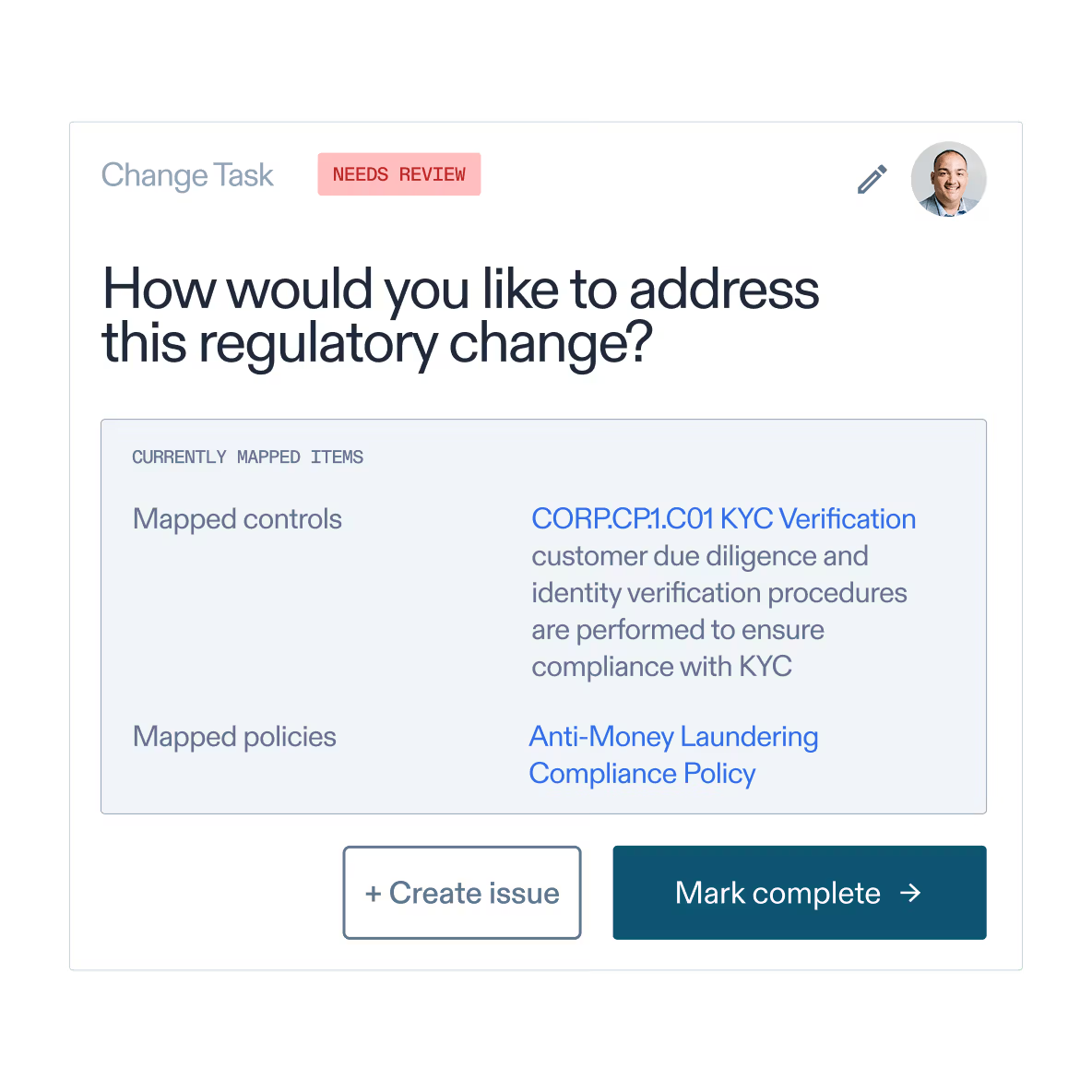
However, RegComply’s most powerful feature is that it is a part of a holistic GRC platform — AuditBoard’s Connected Risk Universe. When compliance professionals and their risk and assurance colleagues work from a shared source of data, they are empowered to centrally manage their risks, controls, policies, and issues – enabling them to manage their risk and compliance posture holistically. Compliance teams that have utilized AuditBoard to automate their compliance programs experienced the following benefits:
Learn how AuditBoard can help your organization accelerate its regulatory compliance efforts, and sign up for our upcoming webinars in 2026.
The forces reshaping today’s regulatory landscape demand a new compliance operating model, one that is proactive, connected, and geared toward enabling strategic decision-making. AI tools offer compliance teams the foundation to achieve this shift, unifying fragmented compliance processes, reducing manual strain, and enabling real-time visibility into risk. Leaders who embrace AI solutions today will not only meet emerging regulatory expectations but also elevate the role of compliance as a driver of resilience and long-term enterprise value.
Learn more about AuditBoard’s AI solutions by contacting us for a personalized walkthrough today.
Natalie Dytrych is a Senior Product Marketing Manager for Regulatory Compliance at AuditBoard. She has 8 years of experience helping financial institutions navigate complex regulatory compliance and risk challenges, most recently as a Senior Manager at PwC.